What Are the Best Recording Studios in Philadelphia?
Philadelphia invented a sound. The lush strings, tight rhythm sections, and silky vocals of 1970s Philly soul were built at Sigma Sound Studios, where Gamble & Huff and Thom Bell cut the Philadelphia International catalog that shaped R&B for a generation. Sigma itself closed in 2003, but the city’s studio culture never left — it scattered into a network of rooms run by engineers who learned the craft when “the Sound of Philadelphia” still meant something specific. Today the recording studios in Philadelphia range from neo-soul institutions to boutique mixing suites, and the best recording studios here still trade on that lineage of clean, musical records made by people who actually play.
This guide covers six working Philadelphia recording studios — every one verified as operating in 2026 — across the city proper and the close suburbs that locals treat as part of the scene. Whether you want a large-format live room for a full band, a string-friendly space descended directly from the Philly International tradition, or a focused vocal-and-mix room for hip-hop and R&B, there’s a studio in Philadelphia on this list for it. Below you’ll find what each room is best known for, who works there, and how to think about choosing among the city’s music studios in Philadelphia.
Table of Contents
- 1. MilkBoy the Studio — Callowhill
- 2. Studio Crash — Fishtown
- 3. Rittenhouse Soundworks — Germantown
- 4. Morningstar Studios — East Norriton
- 5. Kawari Sound — Wyncote
- 6. Lil’ Drummaboy Recordings — South Street
- Frequently Asked Questions
1. MilkBoy the Studio — Callowhill
Best Known For: Being Philadelphia’s most recognizable full-service studio, and the direct successor to Larry Gold’s legendary neo-soul facility.
MilkBoy was founded in 1994 by Tommy Joyner and moved into its Callowhill location at 7th and Callowhill in 2012, taking over the room previously run by Philly legend Larry Gold — the cellist and arranger whose strings defined the Philadelphia International sound. In its earlier incarnation as “The Studio,” that same space became the home of neo-soul, hosting The Roots, Jill Scott, Musiq Soulchild, and John Legend during the late-1990s and early-2000s peak of the movement.
Under MilkBoy, the room has stayed at the top of the city’s roster, with credited work involving artists such as Miley Cyrus, Meek Mill, Dave Matthews, and The Roots. Joyner heads the engineering team, which the studio says works on over 100 records and demos a year. With a deep mic locker and a stack of analog gear, it remains the default answer when Philadelphians name the city’s flagship studio.
2. Studio Crash — Fishtown
Best Known For: One of the few large-format professional live rooms left in the city, built for tracking full bands.
Studio Crash started in the mid-1990s as a private high-end room for musicians Ed Hamilton and Dave Falciani, then opened to outside clients. In 2000, engineer Michael Harmon — who carries multi-platinum and multi-Grammy album credits — joined as chief engineer and bought the studio in 2003. It has served the Philadelphia area for over 25 years.
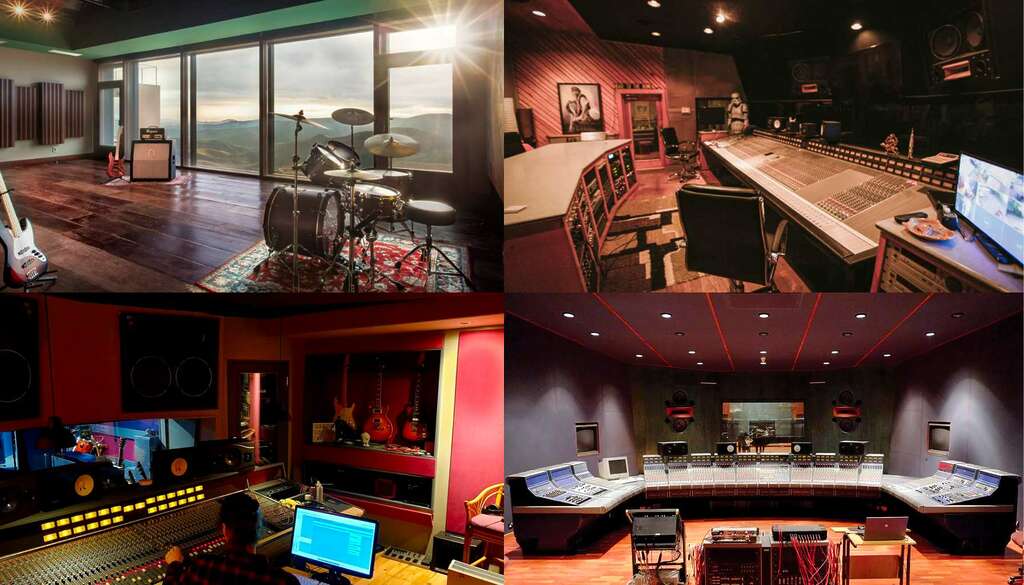
In 2011 the studio moved into a 3,700-square-foot commercial building in Fishtown with a large control room, an 840-square-foot live room with 14-foot slanted ceilings, an isolation room, a vocal booth, and two amp closets. That kind of square footage is increasingly rare in a city where most rooms have shrunk to a booth and a desk, which makes Crash a go-to for rock, R&B, and anything that needs real bands tracking together in one space.
3. Rittenhouse Soundworks — Germantown
Best Known For: A nearly 3,000-square-foot brick-walled live room that can hold an orchestra, paired with a high-end analog control room.
Set in Philadelphia’s Germantown neighborhood at 219 West Rittenhouse Street, Rittenhouse Soundworks offers close to 3,000 square feet of recording space with natural brick walls and high ceilings — enough room to comfortably record orchestras, big bands, or a solo artist, with the kind of warm natural acoustics those surfaces produce.
The control room pairs modern monitoring with classic analog signal path, including Pultec EQs, Tube-Tech compression, and Bricasti reverb. Practical touches like free 24-hour parking and amenities for long sessions make it a comfortable home for ambitious, larger-ensemble projects that simply won’t fit in a typical city studio.
4. Morningstar Studios — East Norriton
Best Known For: A 2x Grammy-winning engineer-producer and decades of polished records just outside the city.
Morningstar Studios sits in East Norriton, minutes from Philadelphia, and is run by Glenn Barratt, a two-time Grammy Award-winning engineer-producer. The studio has served the greater Philadelphia music community for over 30 years and runs essentially around the clock.
Barratt’s credits span genres, and the studio’s resume includes Grammy-recognized work — among them The Crossing’s recording of Ted Hearne’s “Sound from the Bench,” the choral ensemble conducted by Donald Nally. For artists who want a seasoned, award-credentialed producer and a destination room a short drive from Center City, Morningstar is one of the region’s most established choices.
5. Kawari Sound — Wyncote
Best Known For: A world-class room built into a historic carriage house just outside Philadelphia.
Kawari Sound occupies a converted carriage house in Wyncote, PA, on the city’s northern edge — a setting that gives it the kind of character and natural acoustics a purpose-built commercial room rarely matches. It’s owned by Bobby Washington, with engineers including Matty Muir handling sessions.
The carriage-house layout lends itself to bands and acoustic-leaning projects that benefit from a real, lived-in space rather than a sterile booth. For artists who want a destination studio with personality but still want to stay close to Philadelphia, Kawari is a long-running option worth a look.
6. Lil’ Drummaboy Recordings — South Street
Best Known For: A boutique studio and audio-engineering school in the heart of the city, strong on hip-hop, R&B, and artist development.
Located at 818 South Street, Lil’ Drummaboy Recordings is a hybrid of full-service studio and creative mentorship hub. Founder Samori Coles launched his career as a songwriter, artist, and producer in 1996, and the studio has supported Philadelphia’s artists and producers for over 25 years with recording, mixing, mastering, and editing.
What sets it apart is the teaching side: its Music Technology & Recording Program, established in 2004, runs one-on-one audio-engineering and production training for students of all ages alongside commercial sessions. For independent and emerging artists — especially in hip-hop and R&B — who want to record and learn the craft at the same time, it’s a distinctive fit right on South Street.
Frequently Asked Questions
How much do recording studios in Philadelphia cost?
Rates vary widely by room, engineer, and project, and most professional studios quote per session rather than publishing fixed hourly prices. A boutique vocal-and-mix room costs far less per hour than a large-format live room with a senior, award-credentialed engineer attached. Because pricing changes constantly and often depends on whether you bring your own engineer, the only reliable number is the one you get by contacting the studio directly with your project details.
Which is the best studio in Philadelphia for beginners?
For a first-time artist, the most valuable thing is a patient engineer and a room that doubles as a learning environment. Lil’ Drummaboy Recordings is built around exactly that, pairing commercial sessions with a long-running audio-engineering program. Smaller boutique rooms generally feel less intimidating — and cost less — than booking a flagship live room before you know what you need.
Which Philadelphia recording studio is best for hip-hop versus rock?
For hip-hop and R&B, a focused vocal-and-mix room like Lil’ Drummaboy Recordings is a natural fit. For rock and full-band tracking, you want a large live room where musicians can play together — Studio Crash in Fishtown and the orchestra-sized space at Rittenhouse Soundworks are both built for that. MilkBoy the Studio handles the full range and is the city’s most all-purpose flagship.
Do you need to be signed to book a recording studio in Philadelphia?
No. Virtually every studio on this list works with independent and unsigned artists, and several — like Lil’ Drummaboy — are oriented specifically toward developing them. Studio time is a service you book directly; a label deal is not a prerequisite. You just reach out, describe your project, and schedule a session.
What is the most famous recording studio in Philadelphia?
Historically, the most famous was Sigma Sound Studios, birthplace of the Sound of Philadelphia and home to Gamble & Huff’s Philadelphia International recordings; it closed in 2003 and the building earned a spot on the city’s historic register. Among studios operating today, MilkBoy the Studio is the most recognizable — partly because its Callowhill room is the direct successor to Larry Gold’s neo-soul facility that recorded The Roots, Jill Scott, and John Legend.
Written by Alex Tarlescu for Get More Streams. Studio details reflect publicly available information as of 2026; availability, services, and ownership can change, so confirm directly with each studio before booking.